
Mission kit · Command, Control & Communications
Elevates the TW-875 TSM Ghost, which adds flexibility in deploying and extending TSM networks with a simplified radio design and built-in battery.

01
The payload
Kit components


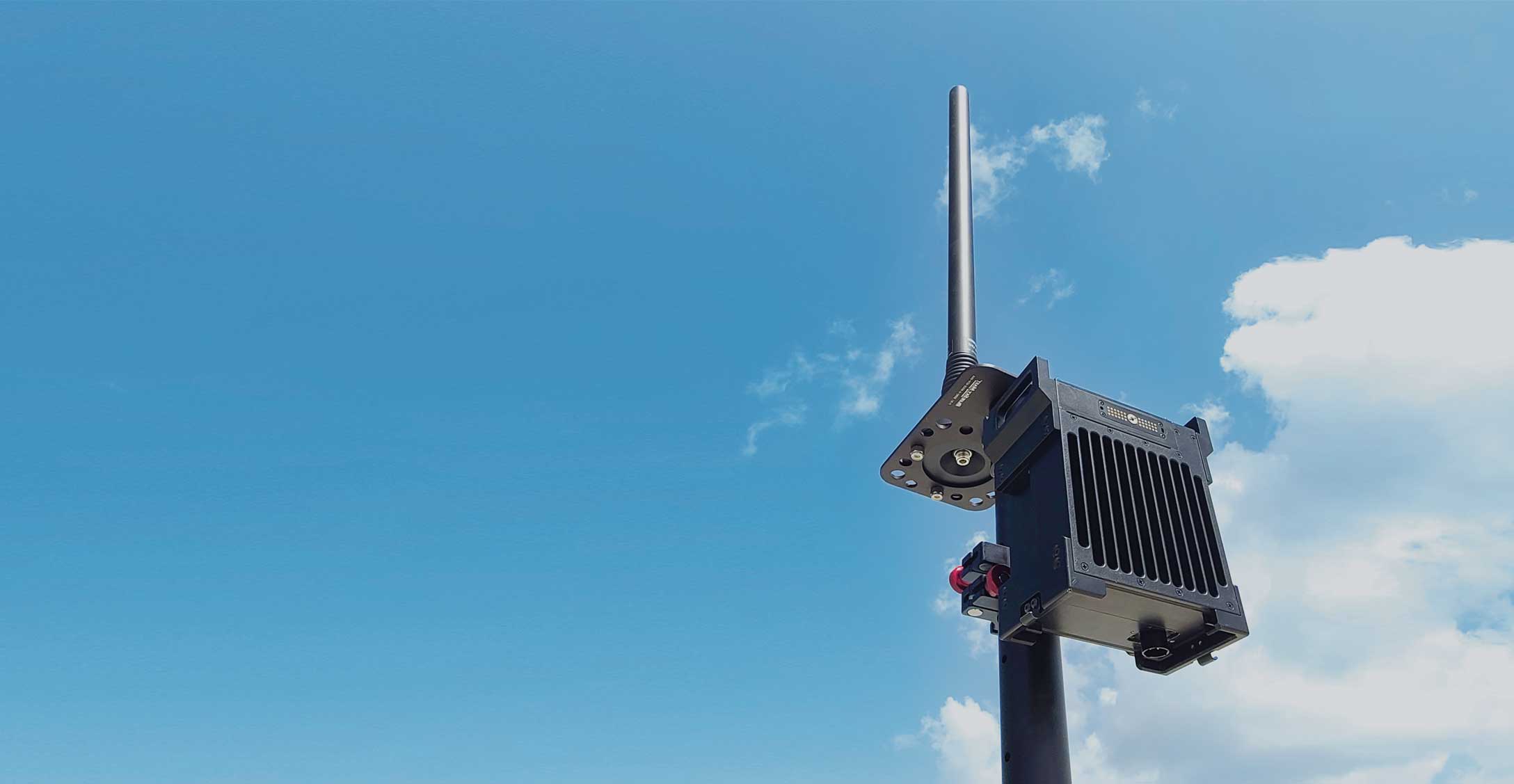
Configured on the 200 Standard Series - AL1
TrellisWare designs advanced waveforms and communications systems, from small form factor radio products to fully integrated solutions.
02
The mast
04
In use
05
Questions
The Silvus Technologies TRINITY integrated antenna and radio system is raised on the BlueSky Mast 350 Lift Series to 12 m (38.5 ft). Two people set it up in about 30 minutes.
The Cambium Networks PTP 700 MLoS Connectivity Kit is raised on the BlueSky Mast 350 Lift Series to 18 m (59 ft). Two people set it up in about 30 minutes.
Tool-less accessories and custom vibration-dampening mounts secure C2 products and systems with a quick connect and disconnect. A custom mast top adapter is available for sensors, and NyCoil cable management is available for cabling.
Yes. The FM Series supports C2 on-the-move and at-the-halt. It integrates with existing Army ground vehicles and ground combat systems, is optimized for brigade combat teams (BCTs) and above, and suits the mobile command post. Crews can raise and retract it quickly from within combat vehicles.
Yes. Its rugged design is built for harsh conditions, including sand, dust, ice and snow. Sections can be fitted with sand scraper rings, and it needs minimal maintenance.
On vehicles, shelters or open ground. A wide range of mounting options and accessories adapts the mast to each site, and customized solutions are available.
MIL-STD-810G, MIL-STD-461F, MIL-STD-1275E, MIL-STD-1686C and MIL-STD-464C.
It is electro-mechanical. A base block with a brushless motor drives the mast, and a remote control sized for gloved hands operates it. RS422, RS485, Ethernet and CAN bus control protocols are available.
Yes. The MEC Series can be kept extended while the vehicle is moving, and it holds its height at any intermediate position.
Catalog models carry 154 to 265 lb, depending on diameter and height. Other masts are available with payloads up to 400 kg.
Catalog models extend from 4.02 m to 20.06 m (13.2 to 65.8 ft). Other masts are available with extended heights up to 25 m.
Yes. FM Series masts have a cold weather defrost system and a drainage and defrost port.
Very little. The masts are nearly maintenance-free and only need an occasional wash down with clear water.
Each mast adapts to the platform: a HMMWV bumper, trailer, receiver hitch, the ground, a wall or the transportable QuadPod mount. It mounts vertically or tilts horizontal for travel, and custom mounts are available.
By a manual or electric winch (12 VDC, 24 VDC or 120 VAC). Upper and lower electro-mechanical safety switches stop the mast at the ends of its travel.
25 to 200 lb, depending on the model: 25 lb and 50 lb models from 10 to 70 ft, 200 lb at 20 ft and 150 lb at 40 and 70 ft. Other masts are available with payloads up to 1,500 lb.
Standard models extend from 10 to 70 ft. Other masts are available with heights up to 100 ft.
70 mph wind loading, tested to MIL-STD-810H.
It packs down into one custom 54 x 14 x 14 inch wheeling carry bag. A 62 x 21 x 14 inch hard case is an optional upgrade.
The 7 to 10 m models ship with a primary guy kit: four red guy ropes, a primary guy ring and four guying stakes. On the 2 to 6 m models a guy kit is optional.
It is a manual push-up system. One or two people push the lightweight 2 in. OD interlocking mast sections up by hand through a patented cam lock tripod, in 2 to 30 minutes.
50 lb at 2 m and 30 lb at 10 m. Payload is the total weight of all devices, accessories and cabling mounted on the mast.
Models range from 2 to 10 meters (7.5 to 31.5 ft), in 1 m steps.
Guyed BlueSky masts are rated for 70 mph (200 Series) or 90 mph (350 Lift Series) wind. Follow the user manual for guying and site setup.
No. BlueSky tripod masts are carried in and raised by hand or winch.
Yes. Masts carry cellular and Wi-Fi equipment; the network itself comes from your carrier or integrator.
Yes, within the mast's rating at the chosen height.
2 to 30 minutes for a 200 Lift Series - AL2 with one or two people; 2 to 5 minutes for a Sidekick.
No. Mounts and sections are tool-less.
2 to 10 m on the Standard Series, up to 15 m on the 200 Lift Series - AL2, up to 18 m on the 350 Lift Series.
Yes. Side arms and top plates carry sensors and antennas.
As long as needed, guyed and within its wind rating (70 mph for the 200 Series).
The mast itself needs no power; solar panels and batteries at the base power the payload.
Yes. BlueSky Robotics builds the jEKYLL tracked UGV.
Yes. A 200 Lift Series - AL2 raises a MANET relay to 10 m in about 15 minutes.
The MEC Series height and position can be read and set from a PC, laptop or remote control (RS422, RS485, Ethernet or CAN bus).
The MEC Series lifts up to 400 kg to heights up to 25 m.
The MEC Series can; tripod masts are for sites at the halt.
In a wheeled carry bag that fits in a response vehicle; the Sidekick is airline-checkable.
Yes. The tripod stands on hard surfaces, and the Sidekick is built for rooftops.
Yes. Top plates and side arms take radios, cellular equipment and cameras within the mast's rating.
No. BlueSky tripod masts are raised by hand or by winch and stand on their own.
The Sidekick in 2 to 5 minutes by one person; the 200 Lift Series - AL2 in 2 to 30 minutes by one or two people.
The 350 Lift Series is rated for 90 mph guyed; masts are anodized aluminum with stainless hardware, and grounding kits are available.
FM Series masts mount to vehicles and trailers; the 200 Lift Series - AL2 tripod deploys from the truck at each stop.
Two people raise the 350 Lift Series in 15 to 30 minutes; lowering and packing is faster.
Yes, on tool-less top plates and side arms, within the mast's rating at that height.
High enough to see over the terrain and the fence line; fielded BlueSky radar setups run at 15 to 18 m on the 350 Lift Series.
BlueSky offers grounding kits and lightning-protection accessories for every tripod mast.
50 lb at 18 m, with a 90 mph wind rating when guyed.
Yes. Side arm kits offset a second antenna from the mast.
Yes. A guyed mast holds the antenna steady and aligned; free-spinning guy rings let you rotate it after it is up.
Enough to see over terrain, foliage and buildings toward the emitters. The 350 Lift Series covers 5 to 18 m.
Yes. The Sidekick is built for rooftops and hard surfaces, and the 200 Lift Series - AL2 deploys at 5 m on a rooftop with a non-penetrating gravity pad.
Yes. Tool-less top plates and side arms put several devices on one mast, as long as their combined weight stays within the mast's rating at that height.
One person sets up the Sidekick in 2 to 5 minutes. One or two people raise the 200 Lift Series - AL2 in 2 to 30 minutes. Two people raise the 350 Lift Series in 15 to 30 minutes.
The 200 Lift Series - AL2 carries 50 lb at 10 m and is rated for 70 mph wind. The 350 Lift Series carries 125 lb at 10 m and is rated for 90 mph.
High enough to clear the terrain, trees and buildings around the site. Most fielded BlueSky C-UAS setups run at 5 to 10 m on the 200 Lift Series - AL2; long-range radar nodes go to 15 to 18 m on the 350 Lift Series.
Yes. FM Series masts mount to HMMWVs, trailers and fixed sites, and the MEC Series holds a sensor head at a precise height, even on the move.
One or two people raise a 200 Lift Series - AL2 in 2 to 30 minutes, and two people raise a 350 Lift Series in 15 to 30 minutes. Lowering is faster.
Yes. A top plate takes the camera and a side arm takes the radio or antenna.
Guyed BlueSky masts hold a camera steady within their wind rating: 70 mph for the 200 Series, 90 mph for the 350 Lift Series.
High enough to see over fences, vehicles and terrain. Fielded BlueSky camera setups run at about 10 m.
The 200 Series packs into a 54 x 14 x 14 in. wheeled carry bag; the 350 Lift Series ships in two hard cases (three at 18 m).
The 200 Series is rated for 70 mph and the 350 Lift Series for 90 mph, guyed, at the rated payload.
Tall enough for a clear path between the two ends. BlueSky backhaul setups run at 15 to 18 m on the 350 Lift Series, which carries 75 lb at 15 m and 50 lb at 18 m.
Yes. Top plates hold the radio or antenna, and side arms offset a second antenna or a sector panel.
High enough to see over the terrain and buildings between nodes. Fielded BlueSky relays run at 7 m on the AL1 Standard and 10 m on the 200 Lift Series - AL2.
Yes. If a payload does not fit a catalog mount, BlueSky's design team models a custom interface in 3D and puts it into production. Pricing is based on requirements and scope; most custom accessories deliver 10 to 20 business days after final drawing approval.
Shipping: single-system orders ship UPS Ground unless you instruct otherwise. We can use your UPS or FedEx account; FedEx Ground adds one day for scheduling.
Payment: credit card (Visa, MasterCard, American Express) for U.S. shipments; Net 30 terms based on D&B credit; or prepay by wire or certified check for a 3% discount (excludes shipping and handling). Shipments outside the U.S. require prepayment by wire or certified check unless payment terms are established. Credit card payments do not qualify for the prepay discount.
A single system ships in 2 to 3 business days; up to 20 systems in 3 to 5 business days; more than 20 systems in 5 to 7 business days. Custom accessories are excluded and typically deliver 10 to 20 business days after final drawing approval.
Pricing depends on the model, height and accessories your mission needs. Call 1-877-411-MAST (6278) or use the contact form and we will confirm the right system and issue a no-obligation budgetary quote, valid for up to 30 days.
Buy directly from BlueSky, or through GSA Contract GS-07F-5916R or the TLS contract. Call 1-877-411-MAST (6278) or use the contact form to get answers before you buy.
No. BlueSky Mast equipment is exempt from ITAR. Commodity code 7308200000; ECCN EAR99.
The 350 Lift Series, 200 Series tripod masts (AL1 and AL2) and the Sidekick are tested to MIL-STD-810H. Each mast system page lists the standard for that model. The MEC Series is compliant with MIL-STD-810G, 461F, 1275E, 1686C and 464C.
The tripod masts are sectional, not telescoping or pneumatic: interlocking sections built for portability and rapid deployment. The FM Series (winch-driven) and MEC Series (screw-driven) are telescoping vehicle masts. None are pneumatic.
Masts are black anodized aerospace-grade aluminum alloy, with stainless steel hardware and fasteners blackened to eliminate glare. All BlueSky tripod mast guy ropes are Spectra Cord, a woven fiber 10 times stronger than common cable.
AL1 and AL2 masts have a 2.0 in. outside diameter (OD). 350 Lift Series masts have a 3.5 in. OD.
Yes. Optional telescoping tripod struts and urban base plate kits are available, and a non-penetrating Gravity Pad supports 5 m rooftop deployments.
Yes. BlueSky offers certified grounding kits and lightning protection accessories. Combined with the surface wire grounding kit, BlueSky masts have been tested and certified to provide lightning protection equal to or better than an 8 ft copper rod driven into the ground.
Yes. Interlocking mast sections and free-spinning guy rings let the deployed mast be rotated by hand 360 degrees at the tripod base for directional control, even when guyed. A manual tilt assembly adds +/- 22 degrees of tilt adjustment from the ground (see Top Plates & Adaptors).
AL1 and AL2 Standard systems, and 200 Lift Series - AL2 systems from 2 to 10 m, pack into a single 54 x 14 x 14 in. wheeled carry bag, with an optional hard case upgrade. 200 Lift Series - AL2 systems from 11 to 15 m pack into two 62 x 21 x 14 in. hard cases. The Sidekick packs into a 42 x 9 x 9 in. airline-checkable case. 350 Lift Series systems pack into custom hard cases.
BlueSky recommends guying every mast using a four-guy configuration at 80% of the total mast height. Mast systems 7 m and above include a primary guy kit. Mast systems 11 m and above include primary and secondary guy kits.
Yes. Depending on model and height, a single BlueSky Mast can carry multiple devices at once, such as radios, cameras and radar, using tool-less top plates, pole mounts and side arm kits. That is a core purpose of the modular design.
Yes. The FM Series and MEC Series are vehicle-mounted telescoping masts: FM mounts to a HMMWV bumper, trailer, receiver hitch, wall or QuadPod, and the MEC Series can stay extended while the vehicle moves. The tripod masts are self-supporting and independent of vehicles and structures, and can be carried by any vehicle, helicopter or aircraft to the site without a trailer.
200 Series (AL1 and AL2) masts are rated for 70 mph winds up to their maximum deployable payloads. 350 Lift Series masts are rated for 90 mph. See the wind load chart for each system height.
Payload depends on the mast model and height: the taller the mast, the lighter the allowed payload. On tripod masts the 350 Lift Series carries the most, up to 175 lbs at 5 m. The vehicle-mounted MEC Series lifts up to 400 kg. See the load table on each mast system page for the exact rating at every height.
Tripod masts reach up to 10 m (AL1 and AL2 Standard), 15 m (200 Lift Series - AL2) and 18 m (350 Lift Series). The vehicle-mounted MEC Series reaches up to 25 m. The Sidekick is a 2 m man-portable mast.
Standard Series masts are manual push-up systems: the mast sections are inserted by hand up through the tripod. Lift Series masts use a stronger tripod and a self-braking mechanical winch to raise the sections, for a more controlled, easier and safer deployment with heavier payloads.
AL1 Standard: the lightest push-up mast, with thin-wall 2 in. OD sections, for single antennas and lightning protection.
AL2 Standard and AL2 Lift: thick-wall 2 in. OD sections (twice the AL1 wall thickness), stiffer and rated for heavier payloads, from 20 to 100 lbs depending on height.
350 Lift: 3.5 in. OD sections for the heaviest payloads, from 50 lbs at 18 m up to 175 lbs at 5 m, rated for 90 mph wind.
BlueSky Mast builds military mast systems that put antennas, cameras, radars and other sensors up high, fast. There are two families: portable tripod-based masts (200 Standard Series - AL1, 200 Standard Series - AL2, 200 Lift Series - AL2, 200 Sidekick Series - AL2 and 350 Lift Series) and vehicle-mounted telescoping masts (FM Series and MEC Series). BlueSky has fielded more than 45,000 systems.